Perusing A Peruvian Archive
Baldomero Alejos’ collected work featured at Harvard’s DRCLAS

Published On Wednesday, April 12, 2006 11:11 PM
By JEREMY S. SINGER-VINE

Baldomero Alejos, whose photographic documents of life in the Ayacucho region of Peru currently hang in the David Rockefeller Center for Latin American Studies (DRCLAS) building, considered himself a tradesman, not an artist. But considering his unusual talent for composition, dynamism, and detail as displayed in the exhibit, it seems that he sorely underestimated himself.

Alejos worked from 1924 until his death in 1976 as the only professional photographer in Ayacucho, amassing a large, focused body of work which is now making its first appearance outside of Peru.

DRCLAS and the Center for Latino Arts (CLA) in Boston are jointly exhibiting “Retouched: The Photographs of Baldomero Alejos.” The majority of Alejos’ work was studio portraiture, on display at CLA. In his time away from his studio, however, Alejos created a vast photographic archive of the events and people of rural Ayacucho, of which 41 prints will be on view at DRCLAS for the rest of the semester.

The photographs were a long time coming. Shortly after Alejos’ death, a fifteen-year conflict erupted in Ayocucho between the Shining Path Maoist guerrilla insurgency and the Peruvian armed forces. After the conflict ended in 1995, Alejos’ family went back to his studio and found 100,000 glass plate negatives, 60,000 still intact. From this archive Lucia, Peruvian photographer and Alejos’ granddaughter, has begun to print the photographs in the exhibit, the most comprehensive remaining visual record of mid-century Ayacucho.

The wide range of Alejos’ photographs is immediately apparent upon visiting the DRCLAS exhibit. He was, one might say, an equal-opportunity photographer, making pictures of clergy, military men, public officials, the wealthy, the working class, and the poor, establishing many points of comparison among his subjects along the way.

The photographs are notable for their many iterations of the photographer-subject negotiation. While Peruvians were no strangers to photography at the time, cameras were scarce in Ayacucho and the act of photography was conspicuous. It was impossible for Alejos, with his large-format camera, to be unnoticed by his subjects.

Instead, his subjects were all aware of his presence, in some capacity. This varying level of camera-awareness, ranging from posed portrait to near-candid is stimulating and keeps the exhibit engaging.

Alejos’ best photographs succeed for reasons as diverse as his subject matter. Lighting is what makes “San Juan de Dios Hospital” a great photograph—the sun comes from three large windows, bounces off the plaster walls, and illuminates each immaculate hospital bed with gradually increasing intensity towards the back of the room. As the hospital beds recede, the hospital employees arc out from the rear of the room towards us, and their dress changes from the dark suits in the rear to white robes in the front.

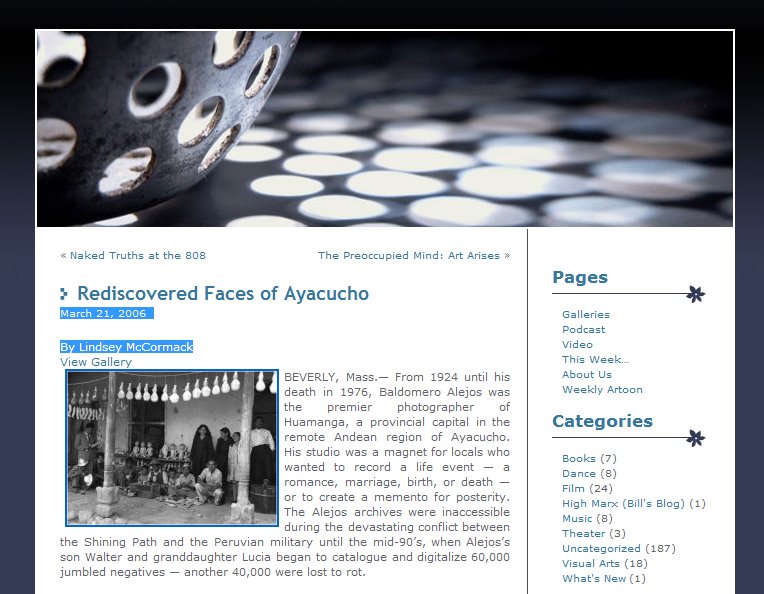
Other photographs are impressive for their balanced complexity. “Typical Nativity Scene” is near-maddening with its hundreds of miniature snow globes, potted plants, dolls, Disney characters, and doilies, but Alejos rescues the scene from pure cacophony. He steps away and sets the nativity scene off-center, transforming it into a cohesive unit. Still, if we come close to the photograph, we can just make out the detail of each miniature.

Yet the most impressive photographs are those Alejos took of peasants gathering in and around town. Perhaps what is so appealing about these photos, besides the repetition of forms and strong composition, is that we get the whole range of camera-awareness in the subjects. It is as if Alejos set up his camera and waited just long enough for some people to forget his presence and become distracted by someone or something else.

The arrangement in “Group of Peasants on Acuchymay Mountain” is clearly for the camera. Yet, perhaps because of the car whose front bumper can be seen in the corner of the photograph, several of peasants are looking off in another direction. A group of men in suits look most intently at the camera, perhaps are most aware of the importance of self-presentation.

At end of the exhibit, “Peasants Gathered at Christmastime in front of the Mayor’s Office” combines the tempered cacophony of “Typical Nativity Scene” with the mixed attentions “Group of Peasants.” Alejos’ camera peers from above a town square upon thousands of peasants.

They are packed so tightly that for the majority we can see little more than a head. Part “Where’s Waldo,” part Jackson Pollock painting, this photograph throbs and pulses as if the viewer is standing in the center of the crowd. Just as in Alejos’ other photographs of gatherings, the viewer notes that the peasants are aware of the camera, but just as many look at their children, siblings, or friends. And even though the photograph includes so many people, almost every face is legible.

Whether or not Alejos’ was an “artist,” he certainly transcended the status of mere tradesman. His documentary photographs can be read not only as artifacts of pre-conflict Ayacucho, but also as confirmation of a coherent aesthetic. These two interpretations are impressively complementary. Rarely do the artistic aspects of his photographs interfere with their evidentiary qualities; more often, the composition, lighting, and perspectives of Alejos’ photographs elucidate relationships among the subjects and amplify the details.

“Retouched: The Photographs of Baldomero Alejos” is open until June 1, 2006 at the David Rockefeller Center for Latin American Studies in the CGIS South Building, 1730 Cambridge Street and at the Center for Latino Arts, 85 W. Newton Street, Boston.

Link: http://www.thecrimson.com/article.aspx?ref=512691

Three Peruvians: Chambi, Alejos, Meinel
by Mark Power

http://markpowerblog.com/2008/12/15/three-peruvians-chambi-alejos-meinel/

Is there something special about the rarified Andean air that influences the visions of three special photographers from Peru? They are Martin Chambi, Baldomero Alejos and Javier Silva-Meinel, and the correspondences between them are striking.

Chambi was from Cuzco and Alejos from Ayachuco, both over ten thousand feet in altitude. But then you have Javier Silva-Meinel who is from Lima at sea level so maybe this theory has to be tempered with the observation that the Hispanic-indian culture that permeates the air in Peru is as important as altitude.

Chambi was himself an Indian; Alejos consistently photographed the Indian culture of Ayachuco and Meinel, the modern photographer in this trio, has spent much time photographing the indians of the Amazon basin, not a surprising choice when you consider half the Peruvian population is of Indian descent. First, there were the Incas conquered by the conquistadores and their descendents the Quechuan Indians , and the Aymara, both of the Andean Highlands, and then the 40 or so tribes of the lowland Amazon region, the subject of much of Meinel’s work. And one mustn’t forget the Hispanic side of this culture: deeply Catholic, reserved and brooding: qualities of light that permeates each of the photographers’ work.

amanecer-en-la-plaza-de-armas1925Martin Chambi Plaza de Armas, 1925


Martin Chambi: 1891-1973

martin-chambi4

self portrait 1922

Chambi’s magic pulses through his photographs, 
the unmistakable magic that distinguishes him from all the photographers with 
whom critics have wanted to compare him, from August Sander and Nadar to Edward Weston, Ansel Adams, Irving Penn, to Abraham Guillen himself. Mario Vargas Llosa

Outside of Latin America, Martin Chambi is the best known of the three, specially since his exhibition at the Mueum of Modern art in New York in 1979.

A working commercial photographer, his studio in Cuzco was well-known in Peru and still exists today under the supervision of his grandchildren.

Martín Chambi’s images laid bare the social complexity of the Andes. Those images place us in the heart of highland feudalism, in the haciendas of the large landholders, with their servants and concubines, in the colonial processions of contrite and drunken throngs. Chambi’s photographs capture it all: the weddings, fiestas, and first communions of the well-to-do; the drunkenness and poverty of the poor along with the public events shared by both. That is why, surely without intending it, Chambi became in effect the symbolic photographer of his race, transforming the telluric voice of Andean man, his millenary melancholy, his eternal neglect, his quintessentially Peruvian, human, Vallejo-like pain into the truly universal. One day Chambi will be recognized as one of the most coherent and profound creators photography has given this century. Amanda Hopinkson, From the book, “Martin Chambi 55″


I have long been fascinated by that curious sub-genre, the Group Photograph and one of its masters is certainly Martin Chambi.

932

Fiesta of the Guardia Civil, Sacsayhuaman, Cuzco,1930.

I’m sorry these photos aren’t a little larger and I know there are even more dramatic examples of this man’s wizardry with groups. Satisfactory examples of all three of photographers are hard to find online so we go with what we can. He is almost unique in his use of deep space in his group photographs and like most of his images they are bathed in that Chambi light, dark and infused with a terrible beauty that characterizes many a Chambi photograph.

927

Wedding of Don Julio Gadea, Prefect of Cuzco, 1930

Look at this justly famous 1930 photograph, for example; it looks like the wedding party is emerging from the deepest depths of the earth. I imagine Don Julio and his young bride have long since returned to those depths but here they are, frozen in time, on the pages of books and hanging on the walls of museums.

928

This man, an indian giant, was photographed by Chambi many times. It is easy to believe that Diane Arbus at some point came across this picture. If not, it is one of those fortuitous examples of images bypassing their makers and speaking to one another directly:

foto4_239

Diane Arbus, Jewish Giant, 1968

Baldomero Alejos: 1902-1976

Alejos is the least known of the three Peruvians – again outside of Latin America and maybe inside as well – and I only became acquainted with his work through the publication of a printing-on-demand book from Blurb.com.

Baldomero Alejos was also a commercial photographer who worked in Ayacucho most of his life, a city once known as a centre of Indian culture, now unfortunately more famed as the home of the Shining Path, Peru’s Maoist guerilla group.

One speculates he must have been familiar with the work of his better known contemporary, Martin Chambi, and a look at his work in this book confirms that impression. It will be up to some future historian to figure out whether the influence was reciproal or one-sided.

Alejos’s group photographs have many of the Chambi trademarks: deep space and the dark light. But this beautiful image is an exception: here the light is bright and luminous. And what an interesting way to compose a group shot so that the environment becomes predominant, making the point that it’s the hospital, the institution, not the people, who is the real subject of this beautiful image.

alejos

This by the way, is the cover of the book, available from www.blurb.com. The text is in German and English so if you speak German you’re probably in good shape but the English is somewhat stilted, as if generated by an automatic translator.

0021

This Alejos photograph of a Peruvian nun illustrates another thing both Chambi and Alejos had in common and that’s the use of natural light studios. The north light, combined with the light of a high altitude, gives both men’s photographs their reserved, somber character.

I remember reading somewhere that Irving Penn , another master of north light, borrowed Chambi’s studio’s when he was in Peru and I wonder if he didn’t borrow a bit from his imagery as well.

pennki1841400Irving Penn, Cuzco, Peru


olejasBaldomero Alejos

The depth of feeling in both Peruvians’ work is extraordinary. I wish I had more to add of Alejos’ imges but so little is available of his work, and despite Chambi’s two books that’s true of his oeuvre as well. Relatively few Chambi pictures have been published, a small part of his archives, and when you consider the Alejos archives consist of over 60,000 images – well, all you can say is, photo historians get to work!

Javier Silva-Meinel, b. 1949

artwork_images_1050_16712_javier-silvameinel

Javier Silva-Meinel is becoming better known these days after several New York shows and a Guggenheim Fellowship for his work about Andean ritual practices. Much of his work has been in with Indian tribes in the Amazon Basin.

His work is distinctly different from his predecessors in that he’s not a documentarian, more a Magic Realist, with a stress on the symbolic and the mythic, firmly in line with the writing of Gabriel Garcia Marquez and the photography of other Magic Realists such as the Mexican photographer, Flor Garduno. Yet resemblances with Chambi and Alejos are many: the use of north light, a deep religiosity, a passion for Indian culture.

14-javier-silva-meiner

I am lucky enough to own a print of this beautiful Indian woman with piranha fish pressed to her eyes. Lately, fish has been some thing of an obsession with Meinel and rightly so since it must reflect the impact fish have had among the culture of the Indian tribes who live along the Amazon.

artwork_images_1050_150948_javiersilva-meinel

artwork_images_1050_150952_javiersilva-meinel

Meinel is sixty years old next year and it is time for some museum curator to take a trip south of the border and give this wonderful photographer a North American museum show with a definitive catalog. And while he or she is at it, they should take a longer look at Peru’s other marvelous photographers, Martin Chambi and Baldomero Alejos.

Rediscovered faces of Ayacucho
By Lindsey McCormack

March 21, 2006

BEVERLY, Mass.— From 1924 until his death in 1976, Baldomero Alejos was the premier photographer of Huamanga, a provincial capital in the remote Andean region of Ayacucho. His studio was a magnet for locals who wanted to record a life event — a romance, marriage, birth, or death — or to create a memento for posterity. The Alejos archives were inaccessible during the devastating conflict between the Shining Path and the Peruvian military until the mid-90’s, when Alejos’s son Walter and granddaughter Lucia began to catalogue and digitalize 60,000 jumbled negatives — another 40,000 were lost to rot.

The exhibit “Retouched: The Photographs of Baldomero Alejos” (through June 1, 2006 at the Casa de la Cultura/ The Center for Latino Arts, 85 W. Newton Street, Boston, Mass. Also at the David Rockefeller Center for Latin American Studies, CGIS South Building, 1730 Cambridge Street, Cambridge, Mass) was organized by Lucia’s childhood friend and Harvard graduate student José Falconi. The show features 150 enthralling images discovered in the archive.

A delightful portrait opens the exhibition; two people nestle close to each other but seem to inhabit different eras. The woman wears traditional clothing and a direct, unadorned expression, as if for a daguerreotype; the man, with his modish sunglasses and unbuttoned sports jacket, strikes a pose straight out of a movie poster. His arm around her shoulder looks less like a tender embrace than the way a gangster might hold onto his moll. Through a perfectly conventional pose, a wonderful play on the artifice of photography is created, a sort of deadpan Peruvian Gothic.

Alejos lived during an unusually peaceful period in long-suffering Ayacucho. His photographs carry a certain antebellum poignancy. (Ironically, one of his last portraits was of the philosophy professor and future guerilla leader Abamiel Guzmán.) Yet these pictures are compelling because Alejos did not approach his job with the apathy of a commercial photographer. He was a perfectionist, elaborating on the playfulness or gravity which his subjects brought to the studio.

Alejos worked only with natural sunlight, skillfully capturing the wide spaces of Andean valleys as well as the subtle expressions of the human face. Given Alejos’s heavy antique box camera and homemade developing equipment, impulse shots were a technical impossibility. Still, the painstaking realism of these photos turns out to be deceptive.

For Alejos, the art of photography lay in the ability to improve on reality just short of making the resulting image unbelievable. His son Walter, who was in Boston for the exhibit opening, explained that Alejos never returned a portrait without first taking a fine graphite pencil and smoothing away black circles and wrinkles, or adding a bit of hair as needed. “He could take fifteen or twenty years off a face,” Walter said, “but if you try to get rid of all the wrinkles it doesn’t look like a person anymore.”

Alejos was proud of his skill at retouching, and the people of Ayacucho were eager to pay for it. A portrait typically cost about twenty percent of a monthly salary; rural families might have to save for months, even years to afford a sitting. Thus to be photographed by Alejos was an honor. In one portrait of an indigent family, the father appears to be holding the photographer’s contract for services rendered: in this way he ensures that the prestige of an Alejos portrait is recorded within the portrait itself.

The contract in the father’s hand also highlights the theatrical quality in these portraits. According to Walter, Alejos was not afraid to send someone home from the studio to comb their hair or try on a different outfit. No wonder, then, that his subjects display considerable self-consciousness about being “onstage.” The musicians done up like gunslingers look ready to shoot their own Mexican cowboy movie; and the proud foursome of toreadors strike the same pose they might use to face down a bull (except, perhaps, the gentle- looking fellow on the right.)

The tendency for exotic self-presentation, especially in women, is also intriguing. Some, such as a society lady in a kimono, wrap themselves in Oriental mystique. Other women dress in the colorful costume of “La Huamanguina,” the folkloric Indian woman of the highlands. As the exhibit notes point out, many of the women dressing as “La Huamanguina” are physically indistinguishable from those who would actually wear the outfit every day, except that their broad smiles and confident bearing give them away as city-dwellers.

To take in the entirety of this wonderful exhibit, the viewer needs to visit two spaces: the David Rockefeller Center at Harvard University, and the Casa de la Cultura/ Latino Arts Center in the South End. The obvious drawback of this setup — many will not have time to travel between both spaces — is offset by the fact that each one functions as a free-standing exhibit. Furthermore, it is important that these photos be displayed in one of Boston’s longest-standing Latino communities. Alejos’s photographs tell a moving story of the creativity and endurance of a culture, and of the social injustices that years of civil war only managed to deepen.

Link: http://artscast.wordpress.com/2006/03/