52 years of

Experience

More than 60,000

Photographs

10 Exhibitions

Locally and Internationally

Exhibited in 5 countries

Peru, USA, France, Germany and Spain

The Photographer / The Artist

Baldomero Alejos

Baldomero Alejos was a photographer who worked for over half a century (1924-1976) in the Peruvian city of Ayuchuco. The artistic quality and the historic value of his images has caused Baldomero Alejos to be recognized as one of the most important Peruvian artists of the last century. His photographic archive consists of of more than 60,000 images documenting life in Ayacucho. The photographs portray the social, civic, religious and cultural life of this special city during the peaceful decades before terrorism gripped the city, and eventually the nation.

Alejos’ unique feeling for natural light and his ability to bring out the most characteristic expression in his subjects made him not only a visual historian of note but an exceptional artist as well. Alejos always searched for beauty in each of his photographs, a search he made for beauty’s sake alone, not for posterity. In that respect, he was a perfectionist. Those who knew him say he would spent long hours in front of a window working on prints and negatives.

Contact us

We are in the main cities of the world. We have offices in Peru (Lima), Spain (Barcelona), USA (San Francisco) and Australia (Sydney).

Bibliography

Production and sale of books about the history of the images of Baldomero Alejos photography archive.

Exhibitions

Planning and coordination of Baldomero Alejos photography archive exhibitions locally and internationally.

Photographs

Projects

Database

The benefits of a database:

1. Complete access to the photographic archive enabling a general scholarly study of the materials as well as aiding the families of people portrayed in the identification of their relatives.

2. Making positive digital images of the negatives, thus avoiding the labor and expense of making monochromatic silver gelatin prints of each.

3. To avoid unnecessary handling of original negatives and prints.

4. Security provided by the duplication of material in case of situations that might adversely affect the photographic archive.

Research

The images of the Baldomero Alejos photography archive are a window revealing the historical, sociological, anthropological and artistic importance of Ayacucho and the country of Peru. With that idea in mind , our objectives are:

• To create a professional documentary film “Baldomero Alejos, Today” featuring the people photographed by the artist as well as those related to him personally and professionally. The film should be done soon due to the advanced age of most of the participants.

• To assemble teams of experts in history, sociology, anthropology, etc, to analyze the archive images from the point of view of their respective disciplines.

Conservation

Conservation and stabilization are two important objectives of the Alejos Photographic Archive. A primary goal is to prevent deterioration of the negatives from careless handling as well as damage from detrimental environmental factors such as humidity and insects. Before being stored in acid-free archival envelopes and boxes, the negatives must be cleaned with specialized equipment.

Once in storage, the archive requires air conditioning and dehumidifiers to maintain a stable environment free of harmful changes in temperature and humidity. Adequate fire safety equipment and security issues are also considerations to be addressed.

Social Aspect

Further development of the Baldomero Alejos archive is sought in order to maximize the artistic historical and social value of the images to institutions, universities, scholars and other interested individuals from Peru, Latin America and the rest of the world. Specifically:

§ The establishment of a Museum of Photography in Ayacucho which would permanently display Alejo Baldomero’s work as well as the work of other Ayachuco photographers. While centered on the culture and identity of Ayacucho, a town known for its artistic wealth, the museum would also endeavor to represent Peruvian culture in general.

Keep yourself updated

Latest News

The years after Baldomero’s work

Celebrating 100 years is always a special and unique occasion. When Baldomero arrived in Ayacucho in 1924, he did not imagine that his photographs would be recognized a century later. A well-deserved tribute that is framed within a great historical…

The darkness that shocked the Andes

When peace went away Every storm is preceded by calm. Ayacucho was no exception. For 50 years, Baldomero Alejos was a visual witness of a city in apparent peace but in which the scene of future violence was silently brewing. Ayacucho…

The reopening of the University of Huamanga

In 1959, a historic event occurred that marked a before and after in Ayacucho: the reopening of the National University of San Cristóbal de Huamanga. It was the response to a unison demand from the entire Ayacucho people, through continuous…

The Photography Lab

The place where art and creation merged Unlike today, in the time of Baldomero Alejos, photography was a complex chemical process that required a lot of time, skill and, above all, technique. It required having a laboratory in total darkness,…

The Photographic Archive

From the beginning, Baldomero Alejos stored all his negatives (glass and acetate) in various boxes, with notes of the months and years in which he had taken them. In 1970, due to the torrential rains, part of the ceiling of the room collapsed,…

Vilcanchos

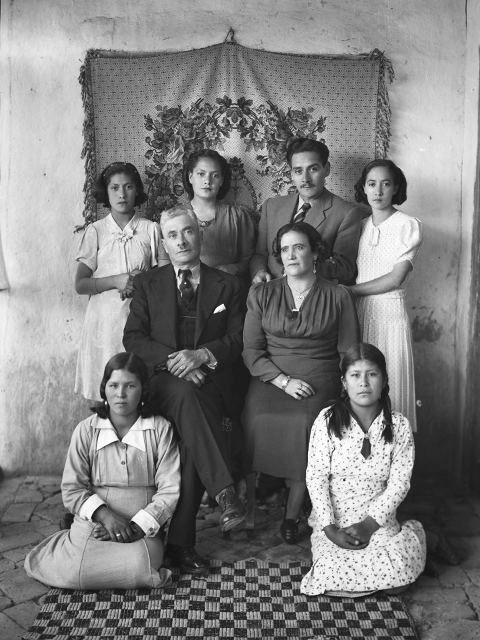
An almost perfect composition. A family that expresses Ayacucho tradition and customs. Women with hats and llicllitas (mantle tied to their shoulders). They wear beautiful embroidered skirts (skirts). Serene and authentic smiles, with dignity…

The precursor of Photoshop

Before the digital era and Photoshop, photographic retouching was a completely manual and artisanal process, a technic for which Baldomero Alejos is recognized worldwide. He followed this procedure: He carefully took a negative on the opaque…

Baldomero’s biography

An entrepreneurial spirit Baldomero Alejos Bautista arrived in Ayacucho in 1924, when he was only 22 years old, motivated by the celebration of American independence. In addition to his dreams, he carried with him his camera, a wooden tripod,…

The art of Baldomero

Baldomero Alejos is recognized as one of the great Peruvian photographers of the last century due to the great artistic quality of his work. An artist who knew how to combine art and science with excellence, the harmony of lights, shadows,…

Ayacucho

Small city, but big in spirit When Baldomero Alejos arrived in Ayacucho in 1924, it was a city of 20,000 inhabitants, few streets and 33 churches. Ayacucho was a small town, but big in spirit and religious fervor, known for having the largest…

Social aspect

Further development of the Baldomero Alejos archive is sought in order to maximize the artistic historical and social value of the images to institutions, universities, scholars and other interested individuals from Peru, Latin America and…

Overview

Baldomero Alejos was a photographer who worked for over half a century (1924-1976) in the Peruvian city of Ayuchuco. The artistic quality and the historic value of his images has caused Baldomero Alejos to be recognized as one of the most important…

Presentation

The last years has been witness of the discovery and recovering of the Baldomero Alejos photo archive. He is recognized as one of the best Peruvian photographers of the past century. His artistic legacy, of more than 60,000 images, is the visual…

Research

The images of the Baldomero Alejos photographic archive are a window revealing the historical, sociological, anthropological and artistic importance of Ayacucho and the country of Peru. With that idea in mind , our objectives are: • To create…

History

For more than two decades after the artist’s death, Baldomeros Alejos’ peaceful images of Ayachuco society remained in the darkness of storage as the violence of irrational terrorism ravaged the city of Ayachuco and eventually all of Peru.…

Digitizing and Archiving

The Establishment Of A Database For The Archive. The benefits of a database: 1. Complete access to the photographic archive enabling a general scholarly study of the materials as well as aiding the families of people portrayed in the identification…

Biography

Baldomero Alejos was born on February 27, 1902 in Amaupata, a village of Santiago de Chocorvos in the department of Huancavelica, Peru. Coming from a family of farmers and shepherds, Luisa Bautista and Alberto Alejos had five sons: Tomas…

Bibliography

Magazines and other publications: Baldomero Alejos’ photographs have been promoted in various professional media thus realizing one of the objectives of the Photo Archive: the knowledge promotion, and diffusion of the work, while emphasizing…

Exhibitions

>>Anachronistic Modernity: The Study Of Baldomero Alejos Museum of Staat Berlin, Ethnology Museum, for the Month of Photography 4 November 2008.– 2 January, 2009, extended to 2 February, 2009 >>Ayacucho Retratado: fotografías de Baldomero…

Conservation

Conservation and stabilization are two important objectives of the Alejos Photographic Archive. A primary goal is to prevent deterioration of the negatives from careless handling as well as damage from detrimental environmental factors such…

Press

Diario El Comercio – Lima, 13 de noviembre del 2008 Artículo en la sección Luces sobre la exposición en Berlín y los avances del archivo en la digitalización y la página web. Diario El Comercio - Lima, 1 de Abril del 2006 Portada…